Waimate

NZ First Said Waste-to-Energy Wasn’t Coalition Policy — So Why Is The Government Advancing It?

Prior to the 2023 election, New Zealand First campaigned on a clear position regarding waste and landfill policy. Its environmental manifesto stated: “Halt creation of any new landfills and urgently advance work on the development of rubbish disposal alternatives through conducting a nationwide recycling and recovery strategy.” It also promised to: “Develop a nationwide Waste-to-Energy strategy.” The policy was framed as urgent.It suggested a future where waste-to-energy (WtE) infrastructure would play a role in reducing landfill dependence while supporting broader recycling and recovery objectives. Yet after entering coalition government, NZ First appeared to distance itself from those same commitments. In correspondence responding to questions about the party’s WtE policy, NZ First media contact Julian Paul stated: “Generally, New Zealand First has not progressed those policy points as they are not in the coalition agreement and we do not have the relevant ministerial portfolio to advance these points.” A separate response from the Office of Winston Peters reinforced the same position, stating that following the formation of government, NZ First was now focused on commitments contained within the coalition agreement with the National Party. At face value, that would appear to settle the issue. Waste-to-energy, according to NZ First itself, was not formally part of the coalition agreement and had not been progressed by the party in government. But events since the election raise an obvious question: If waste-to-energy was never truly coalition policy, why does the coalition government appear to be advancing it anyway? The most obvious example is the government’s decision to include South Island Resource Recovery Limited’s Waimate waste-to-energy incinerator proposal — Project Kea — within the Fast Track Approvals process. That inclusion occurred despite significant opposition from the local community, iwi, local doctors, environmental groups, and concerns raised by the Parliamentary Commissioner for the Environment. At the same time, another proposed waste-to-energy project at Paewhenua/Paewira was excluded from Fast Track despite reportedly being recommended by the advisory panel alongside SIRRL’s proposal. That distinction is important. It demonstrates that ministers were not merely passive observers of WtE proposals moving through standard planning channels. Government ministers actively differentiated between projects, advancing one proposal while excluding another. The contradiction becomes more striking when viewed alongside the actions of Shane Jones. While NZ First publicly claimed it did not hold the relevant portfolios necessary to advance waste-to-energy policy, Jones has since repeatedly emerged around projects and initiatives closely connected to WtE, energy infrastructure, and industrial development.   Shane Jones, REL, and the Long Shadow of Waste-to-Energy Jones has for years maintained a visible affinity toward industrial waste-to-energy concepts and companies linked to the sector, particularly Renewable Energy Limited (REL). That history is politically important because REL is not disconnected from the current WtE debate — it is directly linked to it. REL reportedly holds a 40 percent shareholding in South Island Resource Recovery Limited (SIRRL), the company behind the government fast-tracked Project Kea incinerator proposal in Waimate. In other words, the same corporate network previously associated with controversial public funding decisions has now re-emerged at the centre of one of New Zealand’s most contentious waste-to-energy proposals. The earlier REL controversy centred around Provincial Growth Fund backing advanced during Jones’ previous ministerial tenure. At the time, officials reportedly raised significant concerns internally about the commercial viability of the proposal. Advice later released suggested officials viewed aspects of the project as financially risky and commercially unsound, with one assessment reportedly describing the proposal as a “lemon”. The concern was not simply theoretical. Officials reportedly warned of the risk that public money could ultimately be exposed if the project failed — effectively raising the spectre of taxpayers underwriting a commercially questionable private venture. As scrutiny intensified, Jones later attempted to distance himself from those warnings, publicly claiming he had not seen or received the full advice from officials before funding decisions were made; however, a staffer of Jones’s later provided the media with evidence confirming Jones had in fact been briefed on officials’ concerns. The controversy became politically damaging enough that senior National MP Paul Goldsmith criticised the Provincial Growth Fund culture surrounding such investments, comparing it to: “throwing money around like Pablo Escobar.” That remark has lingered because it captured a wider concern surrounding politically driven regional funding decisions — particularly where large sums of public money intersected with speculative industrial proposals. Viewed in isolation, the REL controversy may have appeared to be a historical Provincial Growth Fund dispute. But viewed alongside: SIRRL’s later Fast Track inclusion, Jones’ continued advocacy for industrial energy projects, his interest in regional energy precincts and Special Economic Zones, and his later visits to overseas waste-to-energy infrastructure such as Singapore’s Tuas facility, a more consistent picture begins to emerge. Rather than waste-to-energy fading from the political landscape after the 2023 election, the same themes, companies, networks and infrastructure concepts appear to have continued evolving inside broader government industrial and energy policy discussions. That continuity matters. Because while NZ First now publicly states that waste-to-energy was not formally part of the coalition agreement, the historical and political trail surrounding Jones, REL and SIRRL suggests the sector has continued to enjoy political interest, ministerial access, and infrastructure momentum from within government circles regardless. The overlap becomes even harder to ignore when viewed alongside Jones’ more recent activities. In October 2024, Jones travelled to Singapore where his itinerary included visits connected to the Tuas waste-to-energy facility alongside broader industrial and energy infrastructure interests. The Tuas development is one of Singapore’s flagship integrated waste-to-energy and resource recovery facilities — precisely the type of large-scale infrastructure increasingly appearing in New Zealand political and industrial discussions. At the same time, Jones has publicly advocated for: regional energy precincts, industrial redevelopment, Special Economic Zones, large-scale infrastructure investment, and energy-related regional growth initiatives. Those themes increasingly overlap with wider government activity involving: Fast Track infrastructure, fuel security narratives, Marsden Point redevelopment, alternative fuel discussions, and industrial energy proposals. Jones also holds portfolios and influence spanning Regional Development, Associate Energy, and Associate Finance — positions capable

NZ First Said Waste-to-Energy Wasn’t Coalition Policy — So Why Is The Government Advancing It? Read More »

Confident Nicola Willis Ruled Project Kea “Not Contrary to NZ’s National Interest” Despite LINZ “Government Bailout” Warning

In February 2024, newly appointed Finance Minister Nicola Willis was required to decide whether the South Island Resource Recovery Limited (SIRRL) “Project Kea” waste-to-energy incinerator proposal was contrary to New Zealand’s national interest under the Overseas Investment Act. Land Information New Zealand (LINZ) prepared a National Interest Assessment Report for that decision. The report did not simply raise local environmental issues. It identified risks going directly to New Zealand’s national interest, including waste-sector dependency, reduced competition, emissions concerns, social opposition, and potential economic exposure if the project failed. Despite those concerns, Willis determined that Project Kea was “not contrary to New Zealand’s national interest”. She also personally removed a safeguard condition recommended by LINZ officials which would have restricted the facility’s feedstock to the South Island and prevented future waste importation from further afield.   The National Interest Risks LINZ Identified LINZ assessed that the project carried a medium national-interest risk in relation to New Zealand’s values and interests: “LINZ assessed that the alignment of the Investment with New Zealand’s values and interests poses a MEDIUM threat to New Zealand’s national interest. The Investment has the potential to undermine New Zealand’s waste minimisation policies and may compete with other Government objectives.” LINZ also assessed a medium social-impact risk: “LINZ assessed that the Investment poses a MEDIUM risk to New Zealand’s national interest in terms of its potential social impacts. There is significant public opposition to the Investment and concerns around the impact of possible emissions to the health and well-being of people, animals and crops.” The report acknowledged that the project could bring jobs, investment, and new technology. But LINZ also identified a serious downside risk if the facility came to dominate South Island waste disposal: “However, the Investment could have a negative downstream impact on the waste sector within the South Island in the event that the Facility dominates the South Island waste sector, potentially creating a significant dependency on its continued operation.” That dependency risk was explained more directly in the report: “If the Investment leads to the Applicant dominating the market for the consumption of the South Island’s waste, some or all of the South Island landfills may close. This could threaten the resilience of the waste disposal market. Specifically, there could be a build-up of waste, with no alternative options for disposal. In this case, a government bailout may be required.” That is an extraordinary warning to appear in a national interest report being considered by the Finance Minister. It shows LINZ was not only considering environmental effects. It was identifying the risk that Project Kea could reshape the South Island waste sector so significantly that, if it failed, the Government could face pressure to step in.   LINZ Recommended a Safeguard LINZ also noted that municipal solid waste incinerators require continuous feedstock: “MSW incinerators typically run 24/7 and require a continuous feedstock supply for decades.” The report warned that Project Kea could create a monopolistic effect on the waste sector: “This may have a monopolistic effect on the waste sector, and in the event that the Facility shut down for any reason, a waste sector with fewer remaining players and potentially lower landfill may present an important economic risk (as well as a potential downstream social risk where waste is not collected).” To manage the risk of the project altering waste flows, LINZ identified a clear safeguard: “The clearest and most achievable condition to manage the above risks would be to require the Applicant to only source feedstock to fuel the Facility from the South Island. This would prevent the redirection of waste from the North Island and ensure the Applicant does not alter its business plan to import waste internationally.” The released report also indicates that the applicant had advised LINZ it did not intend to import waste from overseas and was comfortable with the condition remaining in place. So the position was simple: LINZ identified national-interest risks; LINZ recommended a safeguard condition; the applicant was comfortable with that safeguard; and the report warned that market domination could result in landfill closures, waste build-up, and a possible government bailout. Yet Willis removed the safeguard.   What Willis Told Newsroom On 31 July 2024, Newsroom journalist David Williams asked Willis’ office: “Why did she veto the condition? Was it because of lobbying? If not, what other advice led to that decision?” Willis responded: “Having read the assessment report, I formed my own view which was that the Environment Court was better placed to assess any impacts through the resource management consent process. I do not recall having been lobbied on this matter.”   Willis’ Latest OIA Response Following release of the National Interest Report under the Official Information Act, further questions were put directly to Willis asking why the importation safeguard was removed while other environmental-related conditions remained, what reasoning informed the override of official advice, and whether any additional discussions, consultations, or third-party engagements informed the decision. In her 25 May 2026 response, Willis stated: “I did not consider that the ‘no importation of waste’ condition was necessary to mitigate the risk of harm to New Zealand’s national interest, and that the environmental effects of the proposed model were better assessed through the environmental consenting process, drawing on the appropriate expertise.” She also stated: “There were no additional discussions, informal advice, consultations or third-party engagements that informed my decision.” However, Willis’s reasoning is hard to reconcile, as she left several other environmental impact conditions included by LINZ in place.   The Remaining Question If Willis’ explanation is taken at face value, the position now appears to be: LINZ identified significant national-interest risks; LINZ warned that landfill closures and waste-sector dependency could create circumstances where “a government bailout may be required”; LINZ recommended a safeguard condition to manage some of those risks; the applicant was comfortable with that safeguard remaining; Willis removed the safeguard after reading the report, while leaving other conditions in place; and no additional advice or third-party engagement informed her decision.

Confident Nicola Willis Ruled Project Kea “Not Contrary to NZ’s National Interest” Despite LINZ “Government Bailout” Warning Read More »

Te Rūnanga o Waihao voice opposition to waste-to-energy proposal

Te Rūnanga o Waihao chairperson Dardanelle McLean-Smith said they do not support South Island Resource Recovery Ltd (SIRRL’s) proposal, or its inclusion on the Fast-Track list, a move which had increased their concerns “exponentially”.The iwi had been “really disappointed” in the lack of transparency from SIRRL throughout the application process.“Community input is very important, and from a mana whenua perspective, we are strongly positioned as kaitiaki within our takiwā.“We submitted against the Fast-Track legislation, as the process pins the decision-making on an expert panel and has restrictive time frames.”“It limits our ability to respond in a way that we would like to for that particular process.“It puts a lot of pressure on us. We are essentially a volunteer organisation and we have a very specific position as mana whenua. We hold rangatiratanga within our takiwā.”   “Why should we be the guinea pigs” McLean-Smith said they are concerned about potential health impacts of toxic ash and metal hydroxides that could be created by the plant and question where they will be disposed.She said the plant could lead to a “layering of extremely adverse environmental impacts” in the area.“We also have other impacts that are happening within our takiwā, like the very high nitrate levels in our drinking water.Te Rūnanga o Waihao and Te Runanga o Arowhenua tasked mana whenua-owned Aukaha to create a Cultural Impact Assessment (CIA) for Project Kea.“The CIA gives very tangible evidence of why we don’t agree with the plant and why we don’t want it to go ahead,” McLean-Smith said.“If we had our way it would not have been entertained. It’s just too untested and we are not going to be the country’s guinea pigs.”Waihao board member Melissa Slatter said they were disappointed SIRRL chose the Fast-Track route and said it feels like they are using it to avoid public scrutiny after initially welcoming it.“What’s more outrageous is that it’s been touted as a renewable energy project.“How you can call the incineration of waste and the generation of eye watering volumes of toxic by-products a renewable energy project. Its just farcical. It’s a joke.”Slatter said the plant would have significant, irreversible impacts on the environment, the waterways, the land, the people and the wider community for many generations and they had to say no to the proposal because they were the voice for future generations.“While SIRRL will say they will enlist the latest and greatest technology in these plants, this is new technology to New Zealand and why should we be the guinea pigs?”McLean-Smith said seeing the community groups mobilising against the proposed plant had been really empowering for the people.“When did we decide profits were more important than the health and well being of our mokopuna?” Read Full Article

Te Rūnanga o Waihao voice opposition to waste-to-energy proposal Read More »

Waimate Mayor “Disgusted” by W-t-E proponents actions.

 Waimate Mayor Craig Rowley recalls how “highly disappointing SIRRL’s approach to community communication had been.“ At a Waimate District Council public workshop, on November 19, 2024, Waimate mayor Craig Rowley described SIRRL’s approach to community communication as ‘disgusting’. “When it comes to the proposed waste-to-energy plant, I’m disappointed, disgusted in the way that this council and our ratepayers have been treated, in the way that we have heard nothing from SIRRL in the last 12-18 months at all.” “They have refused to engage with the council or … the waste-to-energy group and the general ratepayers, so I think that it has been exceptionally poorly handled, the way that this whole proposal has been put out there and put to the community.” Waimate District Council request falls on deaf ears. Rowley went further and said he was also disappointed that the project had made it onto the Fast-Track list. On November 12, 2024 The Mayor on behalf of the Waimate District Council sent a letter to Minister Christopher Bishop requesting that the government remove SIRRL’s incinerator plant project called ‘Project Kea’ from the Fast-track approvals list. In a February 12, 2025 Otago Daily Times article, Mayor Rowley said he is yet to receive any response from Minister Bishop.

Waimate Mayor “Disgusted” by W-t-E proponents actions. Read More »

3D illustration of a scale balancing truth and fake news concept against a blue background.

W-t-E company attempts to bully opponents with threat of legal action

On December 1, 2024, Why Waste Waimate sent a letter to Fast-track minister Christopher Bishop raising concerns about the inclusion of SIRRL’s incinerator proposal on the list of projects included for fast-track approval. In a December 30, 2024, Timaru Herald article, SIRRL responded with director Paul Taylor stating the letter contained “factual errors, and has resulted in the company seeking legal advice over possible defamation proceedings”. When requested by the Timaru Herald to elaborate on the “factual errors” and “comments” Taylor referenced, the company refused to do so and a company spokesperson said Taylor’s statement was “all for now”. WWW responded by saying, “WWW stands by the letter and states that Mr Taylor should elaborate on these unsubstantiated claims. If he believes errors were made that require addressing, why is he so reluctant to state what these so-called errors are?” Allegation of abuse The December 30, 2024, Timaru Herald article quoted SIRRL director Paul Taylor saying “Recent correspondence with WWW spokesperson, Robert Ireland had seen them receive only abusive language”. While Mr Ireland accepts he called Mr Taylor a “gutless lying bastard”, he also says “Mr Taylor is omitting the lead-up conversation that resulted in those comments being made.” Furthermore, to claim that recent communication between Mr Ireland and the company had seen them receive only abusive language is untrue. The comment came at the conclusion of an email conversation initiated by Mr Ireland in an attempt to get some information on where the proposal currently stood after a long period of silence from SIRRL. “Mr Ireland emailed Mr Taylor on September 30, 2024, stating that the Waimate community were eager to know where the proposal currently stood and whether SIRRL were pursuing fast-tracking. “On October 3, 2024, Mr Taylor responded ‘When we have all that is required to progress to the next stage our priority will be to update the Waimate community’.” Taylor did not respond to the fast-tracking question. Just three days later the Government announced the list of 149 projects included for fast-tracking with Project Kea on that list. SIRRL lodged its Fast-track application on May 1, 2024. Despite Mr Taylor’s claims, almost three months later, WWW have not received any legal proceedings against them.

W-t-E company attempts to bully opponents with threat of legal action Read More »

Govt Sets Bar Low With SIRRL Fast-Track Application

On December 16, 2024 the government released the applications submitted for fast-track assessment. However, SIRRL’s application shows just how low the government is willing to go when accepting proposals for fast-track inclusion. SIRRL’s application is littered with mistakes, misleading figures, exaggerated claims, inconsistencies, and completely omits the proponents compliance history from its application.  SIRRL’s signed declaration is false and therefore should have been rejected outright.  In an October 6, 2024 press release, Ministers Jones and Bishop discribed the process for inclusion as “thorough and robust”, However, SIRRL’s place on the list of 149 questions the credibility of the government and its processes for fast-track inclusion. Read more about SIRRL’s fast-track application below SIRRL’s Application

Govt Sets Bar Low With SIRRL Fast-Track Application Read More »

National MP’s Grapple With Fast-Track Protest Banners.

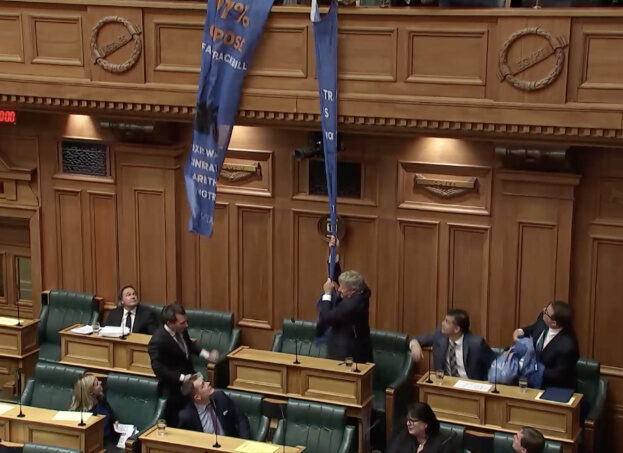
Parliament speeches were briefly halted on Tuesday due to a protest from the public gallery. Protesters shouted “this bill kills” and unfurled a banner, before Assistant Speaker Greg O’Connor ordered they be removed. One of the protesters, Adam Currie from 350 Aotearoa, said communities across the country would continue to fight against projects – especially mines on conservation land. “It doesn’t matter if the bill passes today, because we’re going to be there to stop them, and communities are going to be there to stop them, all across the country. They have no social license to operate.” VIDEO CREDIT: Chino Barrett-Lovie Disaster Waiting to Happen Green Party environment spokesperson Lan Pham said the law was an “unexpected and unwanted Merry Christmas to Aotearoa”. “It’s been really clear from the start that the public didn’t want and still don’t want this bill,” she said. “If they knew the places in communities that would be put at serious risk by these projects, they would not be passing this bill.” She said the Waimate waste-to-energy plant was a “disaster waiting to happen” as such plants had harmful effects to people overseas ‒ and the community did not want it. “And yet, under fast-track, here is a pathway to allow this project to happen.” Read More

National MP’s Grapple With Fast-Track Protest Banners. Read More »

SIRRL: A case study in local democracy and accountability

On Dec 1, 2024, WWW sent Fast-Track Minister Christopher Bishop an open letter document (see below). The document detailing SIRRL’s waste-to-poisons plant and the current governments ‘she’ll be right attitude’ despite Environment Ministry concerns, was accompanied by the following email and sent to all ministers and spokespersons. Dear Ministers, Spokespersons and other.   The 149 projects short-listed for the fast-track approval process includes a proposal to build a massive rubbish-burning incinerator in the Waimate District.  These plants pose significant risks to the local environment and human health. The harm to the Waimate District and the South Island has been overlooked in favour of ill-conceived development and risky design.   The undemocratic act of removing the proposal from the Environment Court process, where it would have been subjected to the necessary scrutiny to determine its full effects, is dangerous to NZ agricultural exports, our communities, and the environment we treasure.  It was announced last week that the proposal for an incinerator at Te Awamutu is being taken to a Board of Enquiry.  This is a smaller(!) project than the Waimate proposal. It raises the obvious question of transparency: what criteria are applied to add projects to the fast-track list to ensure consistency, and how can proposals of more significant impact be subject to lower levels of scrutiny? The attached document underscores the disturbing fact that several government ministers have chosen to disregard the Ministry for the Environment’s advice, which has consistently shown this proposal to be flawed. This advice has also raised serious concerns about the proposal’s proponents, particularly its history and credibility. These same Ministers have disregarded the overwhelming and strong community opposition to this plant, removed the community’s input from the process, and continue to ignore calls from the local Government and community to remove this proposal from the fast-track list. The Government should heed the advice of its officials, remove this proposal from fast-tracking and allow the Environment Court to fulfil its crucial role in scrutinising such proposals without ministerial interference or the artificial and rushed deadlines of the intended Fast-Track process. For the sake of transparency, this email is also being sent to numerous media outlets.   Regards  Why Waste Waimate Inc. www.whywastewaimate.com SIRRL; A case study in local democracy and accountability

SIRRL: A case study in local democracy and accountability Read More »

thumbs down, dislike, thumb, bad, feedback, down, failure, negative, opinion, finger, aversion, dissatisfied, rejected, false, judgment, opposition, thumbs down, thumbs down, thumbs down, thumbs down, thumbs down, dislike, dislike, dislike, bad, failure, negative, rejected, false

Waimate residents emphatically against proposed waste-to-energy plant: Survey

A Waimate District Council survey asking residents if they support a proposed $350 million waste-to-energy plant has received more than 700 responses with an emphatic majority stating their opposition. The result of the survey, which ran from November 5 to 19, showed 94% of respondents were against the proposal. The council received 735 responses to the question: “Do you support a waste-to-energy plant within the Waimate District?” Of those, 697 (94%) answered no, 28 (3.4%) answered yes, and 10 were undecided. The survey was launched on November 5, the same day councillors agreed that mayor Craig Rowley should write a letter to the Government requesting it remove the proposal from South Island Resource Recovery Limited (SIRRL) for a waste-to-energy plant from the list of projects to be fast tracked. Read More

Waimate residents emphatically against proposed waste-to-energy plant: Survey Read More »

Glenavy farmers don’t want W-t-E plant poisoning their land

Farmers in a small South Island town are worried milk and meat produced in the area will be contaminated if a waste-to-energy plant goes ahead. “Cattle and sheep are grazing the grass, which puts a massive negative on our exports if things like toxins are found in our meat and wool for New Zealand,” sheep and beef farmer Ross McCulloch said. The Glenavy site is close to dairy factories and Fonterra’s previously raised food safety concerns about a similar proposed plant in the past. The Glenavy School who is a short distance downwind of the proposed incinerator is also concerned. School board Chaiperson, Adam Rivett said, “the dioxins in the air that these things release. If you look at the studies overseas, some of this is not good and obviously, it impacts children more readily than it does adults.” Watch Full One News Story Below

Glenavy farmers don’t want W-t-E plant poisoning their land Read More »