Waimate

Company remove the need to register personal details to attend information sessions.

In what some described as an attempt to screen participants, people wanting to attend information-sharing sessions were first required to register and provide the company with their personal details. The requirement has now been removed following complaints from the community. “We asked for names and contact details when people registered so we could follow up with project information, but we appreciate that some people felt uncomfortable providing this information, so we’ve dropped the requirement to register attendance. People can now just turn up at any of the sessions.”—Paul Taylor, SIRRL.  READ MORE

Company remove the need to register personal details to attend information sessions. Read More »

SIRRL announced plans to return to Waimate for community consultation but requires attendees to register for sessions with personal details.

It’s only been 18 months. SIRRL announced plans to return to Waimate for what they are calling information-sharing sessions six months after lodging a resource consent application. However, in an unpopular move, the company requested attendees to register for the sessions by providing the company with their full name and email address. Dr Crispin Langston, one of five Waimate GPs opposing the plant, said the group believed the information sessions must be a “truly open and accessible forum.” “We do not believe that the proposed series of self-contained, essentially private meetings will achieve that goal.”   Langston was concerned the requirement for people to register for the meetings would “inhibit free speech”. “It is well recognised that the best way to genuinely hear a community’s concerns is to have a larger public meeting with questions initially sorted and presented on behalf of the audience, before opening to the floor.” Langston also said a “truly open public meeting” also means that, more specifically, informed participants can follow the answers and help others achieve a better understanding.

SIRRL announced plans to return to Waimate for community consultation but requires attendees to register for sessions with personal details. Read More »

Chemical engineer approves Project Kea air quality report despite unreliable data.

Despite withdrawing his support for Bioplant’s proposal to build a pyrolysis plant in Feilding, Andrew Curtis has signed off on two air quality assessment reports for SIRRL’s Waimate incinerator proposal. However, the proposal has faced challenges. The first resource consent application, which included an air quality report provided by Tara Hutchins from Paddle Delamore Partners (PDP) and reviewed by Andrew Curtis, was returned due to a lack of information, including emissions to air. SIRRL lodged a second application that again included a report by PDP, which was also returned due to a lack of information. ECan has assessed the air quality report and stated that the information provided is inconsistent. MORE ON ANDREW CURTIS & PDP

Chemical engineer approves Project Kea air quality report despite unreliable data. Read More »

MGI Irrigation ask for letter of support to be retracted.

SIRRL’s resource consent application to build a waste incinerator in Glenavy/Waimate included MGI Irrigation’s support letter. However, MGI did not approve the letter used by SIRRL and has subsequently asked for it to be retracted.MGI owns the land adjacent to the site proposed for the Project Kea incinerator. MGI uses the land to carry water for irrigation via an open water ace. SIRRL has stated that they intend to lease the land from MGI and build a rail siding over the irrigation channel, which they say they intend to use to bring waste to the site via rail.Why Waste Waimate believes that building a rail siding on land they do not own is unrealistic. Trucking waste to the site via 78 trucks, which will contribute to road congestion, further deterioration of already failing local roads with a lack of sufficient passing lanes, and excessive CO2 emissions, is not a popular proposal. So, how do you counter that? Tell the community you intend to use rail.Dairy developers in the district also said they would build rail sidings, but it never happened. WWW believes it is not likely to occur with the Project Kea development either and is more likely than not just greenwashing. Read MGI letter here

MGI Irrigation ask for letter of support to be retracted. Read More »

SIRRL claim support from WasteCo, MGI Irrigation and Alpine Energy.

SIRRL claims that WasteCo will take the metal hydroxide sludge (MHS) produced at the Project Kea plant and treat it through their facility before the toxic material is landfilled. However, the facility they claim they will use to treat the MHS is still in the design phase. The Project Kea incinerator will produce approximately 1 tonne per day of Metal Hydrogen Sludge (MHS) as a by-product of the plasma furnace process. MHS is a hazardous substance because it contains highly concentrated amounts of very toxic material, including heavy metals. The letter provided by WasteCo, which has been used in SIRRL’s resource consent application, is nothing more than a gentleman’s agreement. WasteCo has not even built the facility the company claims it will use to process the MHS; in fact, at the time the letter was written, WasteCo had not even lodged a resource consent application. Read WasteCo letter here

SIRRL claim support from WasteCo, MGI Irrigation and Alpine Energy. Read More »

Land purchased for proposed W-t-E plant – on a flood zone.

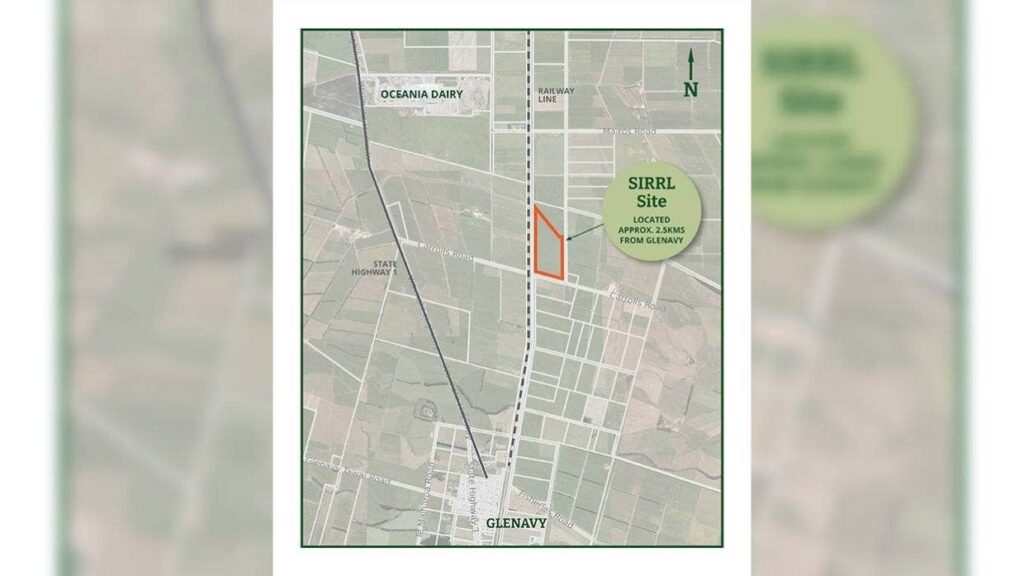
SIRRL has announced that it has purchased farmland in Glenavy/Waimate for the proposed Project Kea waste incinerator, claiming it as the “perfect location.” But is it? Hundreds of kilometres from the waste source, population base, and infrastructure to support it, why choose productive farmland within a food-producing region in a flood zone to site a vast rubbish incinerator? SIRRL’s resource consent states that 71%of the waste they intend to burn will be sourced from Christchurch. This requires 136 heavy truck and trailer movements each day to bring the waste to Glenavy/Waimate, only to return the resulting ash to be landfilled again. SIRRL said they chose the proposed site because of its proximity to the rail line and state highway, which somehow narrowed it down to Glenavy.  They also stated that they would provide energy to neighbouring industries to offset current coal-fired boiler use. Oceania dairy factory is the only industry near the chosen location. In March 2023, SIRRL was asked if they had any agreement with Oceania; the answer was NO. Learn more about the location and chosen site below. The Location

Land purchased for proposed W-t-E plant – on a flood zone. Read More »

Company using outdated historic landfilling practices to compare against W-t-E proposal.

” NZ is in the middle of a landfill crisis; many of the South Island’s landfills are older, over-packed and failing.” – Paul Taylor, SIRRL director. SIRRL continually uses historic landfills that predate the RMA, like the Fox River tip, to compare against Project Kea. Modern landfills are heavily regulated and engineered to avoid events such as Fox River. A huge waste incinerator will not stop historic landfills from becoming exposed due to future weather events. Comparing the company’s proposal against historic landfilling practices is misleading and dishonest. Burying our residual waste in the ground or burning waste and burying the remaining ash are not sustainable solutions. Waste-to-Energy, often touted as a solution, is a false promise. Like landfilling, W-t-E fails to address the root cause of the problem. It merely offers another convenient disposal method, leading us into a cycle that encourages waste production for the next 35 years. We have more options at our disposal than burn and bury; just because landfilling is unpopular doesn’t mean we should settle for W-t-E. There’s a constant stream of new initiatives in waste collection, sorting, and recycling. Futurepost, a pioneering NZ company, is a shining example. They take non-recyclable soft plastics and transform them into useful products like fence posts and raised garden beds. Futurepost is just one of many resourceful NZ companies leading the charge in sustainable waste management. The practice of burning waste to recover a fraction of the energy used to produce it is not just inefficient, it’s a missed opportunity. Especially when there are companies within NZ that are demonstrating a better way. These companies are using the same waste to produce recyclable products, showing us that there are more effective and sustainable alternatives to waste management. More on Waste here

Company using outdated historic landfilling practices to compare against W-t-E proposal. Read More »

Project Kea proposal to proceed without Cultural Impact assessment.

SIRRL’s second resource consent application was returned due to “insufficient information”, in particular, a lack of a Cultural Impact assessment (CIA). SIRRL lodged an appeal, which an independently appointed commissioner heard. Barrister Rob Enright, “by a narrow margin”, found in favour of SIRRL and directed the two councils to accept the resource consent application as complete. This means that the application will proceed and be subject to last century’s Resource Management Act (RMA) regulations that will not be subject to new legislation considering greenhouse gas emissions, potentially impacting the project significantly. READ MORE

Project Kea proposal to proceed without Cultural Impact assessment. Read More »

Young boy showing frustration indoors with hands on head, eyes closed, mouth open.

Councils actions labelled “an abuse of power” by SIRRL director.

After having their resource consent application returned for a second time due to a lack of information including a site specific CIA, company director Paul Taylor spits the dummy and labels ECan and Waimate DC’s actions as “unlawful” and an “abuse of power.” In a letter to both councils dated 23 December, SIRRL director Paul Taylor said the Resource Management Act (RMA) had “no requirements for a Cultural Impact Assessment to be provided as a prerequisite to making a legally competent application.” Company provides historic CIA gleaned from unrelated resource consent application. The company had its September 2021 resource consent application returned due to a lack of information, including a cultural impact assessment report (CIA). The company relodged its application just days before RMA changes came into effect, changes that would mean its application would take GHG emissions into account.  The company’s second application included a CIA from Oceania Dairy Company to discharge wastewater into the ocean. In his letter to ECan, Taylor stated that the CIA ‘meticulously identifies possible cultural value issues and explains why none has material effect or relevance ‘. He further stated that ‘it follows that the Council’s rejection of the application on this basis is perverse and unreasonable in law.’ This letter implies that Mr Taylor believes it is appropriate for him to decide if SIRRL’s application has a material effect or relevance to cultural values. If it were up to proponents of these types of developments to determine cultural effects, then there would be no need for cultural impacts to be taken into account when determining the effects of these types of applications, therefore bypassing Mana whenua from the process. READ MORE

Councils actions labelled “an abuse of power” by SIRRL director. Read More »

Wooden tiles spell 'Fail Your Way to Success' emphasizing perseverance.

Incinerator proposal resource consent application returned a second time due to lack of cultural impact assessment.

ECan spokesperson Hayleigh Brereton said the council believed a site-specific cultural impact assessment with or by Te Runuanga O Waihao was required. “This is a very large proposal and the first of its kind in New Zealand, and it would have some wide-reaching potential effects, including many unknown effects on Mana whenua,” Brereton said. SIRRL director Paul Taylor said the company was considering legal advice on whether this decision was a breach of legal process and whether processing of the other reports that made up the Project Kea application should proceed in the meantime. Read More

Incinerator proposal resource consent application returned a second time due to lack of cultural impact assessment. Read More »